Tibetan Life At Yulong Xueshan
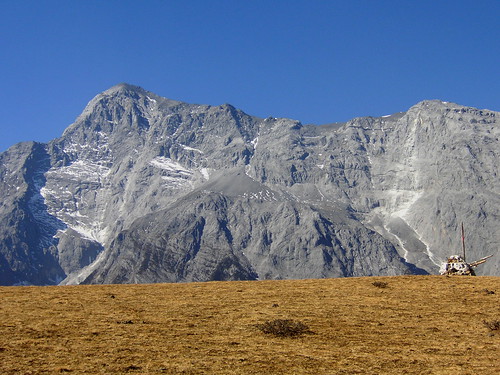
I’ve begun to suspect that one doesn’t get above about 3000 meters in China without finding Tibetan people. This is pretty cool since it often means you’ve got interesting cultural and religious aspects added to what’s invariably a beautiful environment to begin with. (See my photos from Labrang Monastery at Xiahe, Gansu, from last August for some other
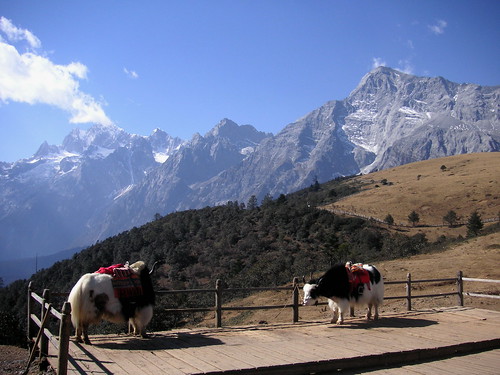
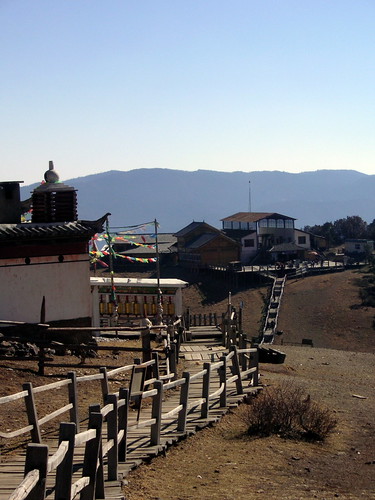
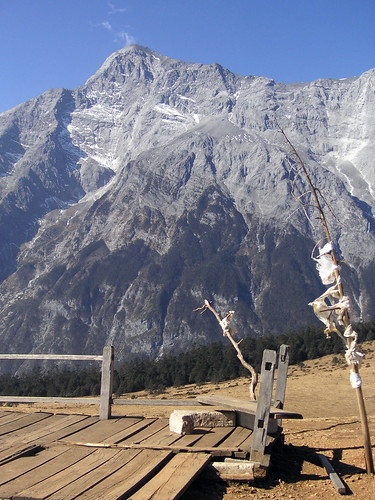
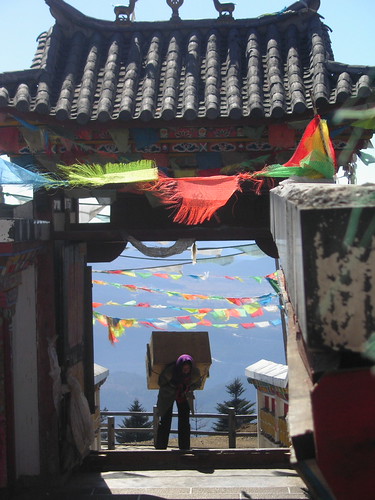
examples.) In any case, sure enough at Yak Meadow on the slopes of Yulong Xueshan, we came across a small temple, prayer shawls and prayer flags wrapped around various items, and even a few signs of sky burials, as seen this shot.
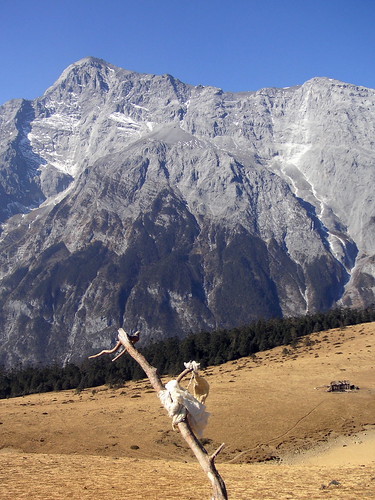
Yulong Xueshan

Since a blog by nature presents the most recent stuff first, yet I’m processing two months’ worth of photos all on one weekend (it’s New Year’s weekend here in China – so I’m avoiding all the firecrackers outside by posting all these photos from my peaceful apartment…), it’s hard to convey
the sequence of discovery we went through. We left Lijiang, a town you’ll
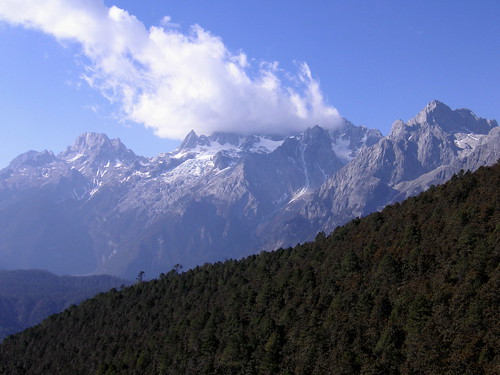
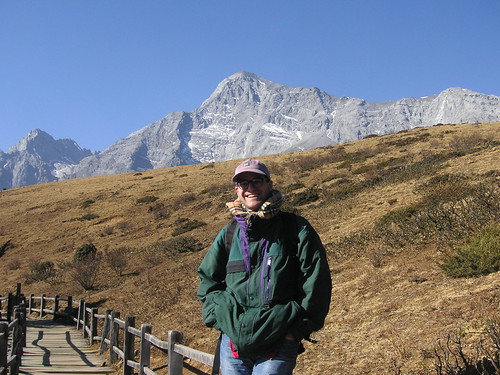
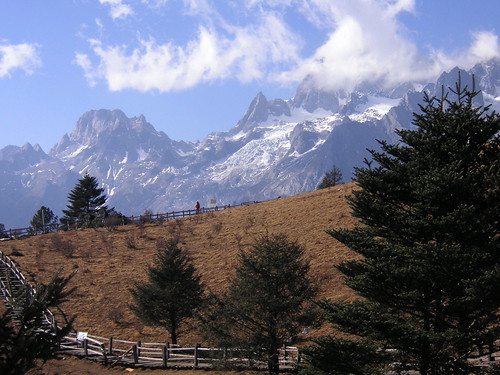
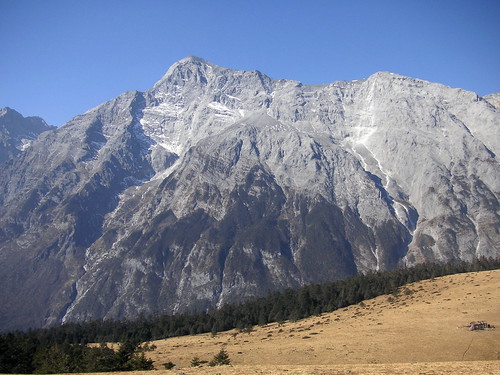
see shortly, and drove about 1-1/2 hours north to reach the chair lift up to Yak Meadow, which you’ve been looking at. The meadow is at about 3500 meters, and as you’ve seen the peak of the mountain towers another 2000 meters (that’s 6000 feet, or the height of the Smoky Mountains, to you metrically illiterate Americans) above it.
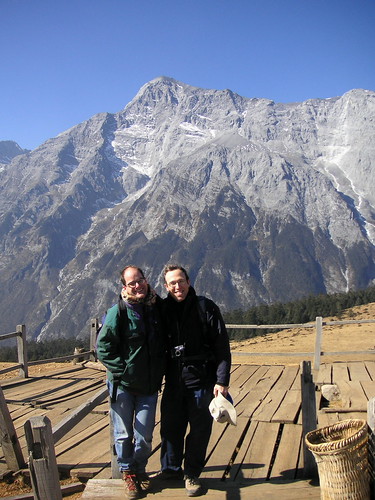
Were it not for high winds, we might have gone up another lift to the 4500-foot high cloud fir meadow, from which Lonely Planet says you can see “awesome glacier views.” My capacity for ever-increasing levels of awe was certainly tested by the gorge and by Yulong Xueshan…so I suppose it’s possible I could find another angle even more awe-inspiring and beautiful than what Howard and Gene and I saw from Yak Meadow and from the paths through the gorge. So I guess I’ll have to get back to see the glacier some time! And pray global warming gets no worse, huh?
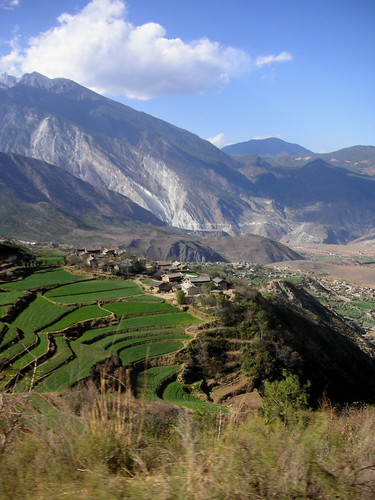
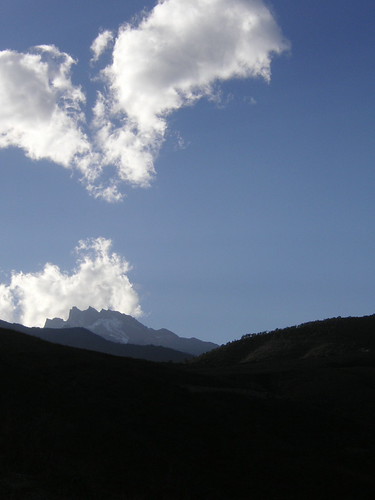
In any case: what follow are many views of Yulong, from the south or southeast side: the gorge is up and over from where these were all photographed. The shot you’re looking at now – green fields in the foreground – is taken from the town of Daju, which marks the downstream end
of Tiger Leaping Gorge. We waited (patiently in my case; with some anxiety in the case of H&G 🙂 ) for the bus up at the top (well, at the base of the Yak Meadow lift, top being a relative term in this case) and took the breathtaking and frightening mountain road down to Daju, in order to cross the river and start out hike through the gorge. I took this shot as the bus
barreled over the dirt roads entering town.
Lijiang Old Town, Yunnan
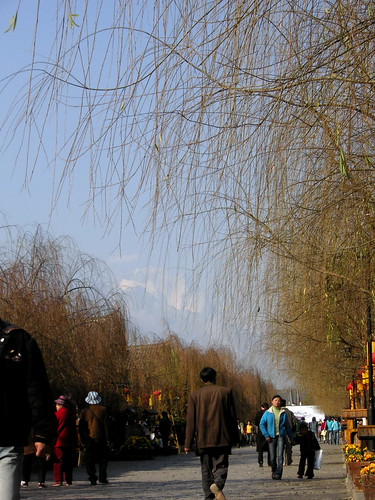
Most people heading for Tiger Leaping Gorge get there from Lijiang, probably
the most famous tourist spot in Yunnan. It seems a decade ago this was a fairly remote outpost of the backpacker crowd, as was Tiger Leaping. The gorge is still rather rugged and geared more at the backpacker crowd than anyone else — though with the road now covering the entire length, it’s only a matter of time before the tour buses come in.
Lijiang, on the other hand, is firmly entrenched on the tour-bus itinerary
now, so you can see the usual crowds of tourists (mostly Chinese or other
East Asian: it seems most westerners here still travel solo or in small
groups) trooping along after a loudspeaker-bearing and flag-waving (makes them visible in the crowds) guide. While this crowds the streets up and increases commercial pressure on anyone walking the streets (as in, “hello!
hello! come in, taste the tea, see beautiful paintings!”), nothing can
change the fact that Lijiang is a gorgeous city, graced with lovely car-free streets (in the old town) and goldfish-filled canals, in a beautiful setting.
Before getting there, none of us had quite taken in the fact that, 40km north of town, sits what can fairly be described as the first mountain of the Himalayas. So you can imagine our surprise when we looked up from one of the town squares to see what was clearly a massive mountain rising in the distance.


 (so much world, so little time....)