I wasn’t sure how it would feel, to return to Beijing as my home and place of work, after such an extended vacation surrounded by friends and family – after all, whenever I’ve lived abroad before, I’ve been there for a period of time without coming back the US, then when I left it was over and I was back to the US and whatever life I needed to resume there. I find I’m learning what the extended expatriate life means, and it’s an interesting unrolling in ways good and bad, happy and sad and lonely and connected all at once.
First off, Beijing feels just like home…as does the US. This, I suppose, is what it means to “have one foot” in two different places. Neither feels take-for-granted comfortable in the way, say, New York did during my long years there. But both feel perfectly homelike and comfortable; oddly, Beijing feels almost more like home now that I’m back to it: all the stuff I’ve lived with for the past year is here, my office and the people who need/want me to work with them are here, so it truly is a homecoming. Nonetheless, I’m still trying to have newly fresh senses for the sights, sounds and (oh, yes, especially now that it’s hot summer) smells of Beijing. During my Friday morning run, I passed this melon vendor on his horse cart on a street that’s a very popular route for people bicycling to work — at the hour when I run, it feels like 10,000 bikers all heading south, and me running north against the flow of bikes. I wish I’d had my camera to catch that image: scads of bikers passing the melon man and his horse cart.
But I had to go back on my way to work with the camera, by which time bicycle rush hour was already past and the man was napping atop his cart. With summer harvests here, there are more horse and donkey carts on the roads: Beijing’s answer to the Santa Monica Farmer’s Market is guys who load their carts up with watermelons, musk melons, or bokchoy in the wee wee hours (or the night before), hitch it to their horse or donkey before the sun rises, and make their way into the city to sell their produce to workers on their way to the office. It’s a reminder that horses and donkeys represent a far lower capital outlay than an automobile, and cost far less cash in upkeep and maintenance. In Nanning, it seemed most of the produce vendors road their bikes, fully loaded on the back with whatever they were selling…but that wouldn’t work for heavy stuff like melons.
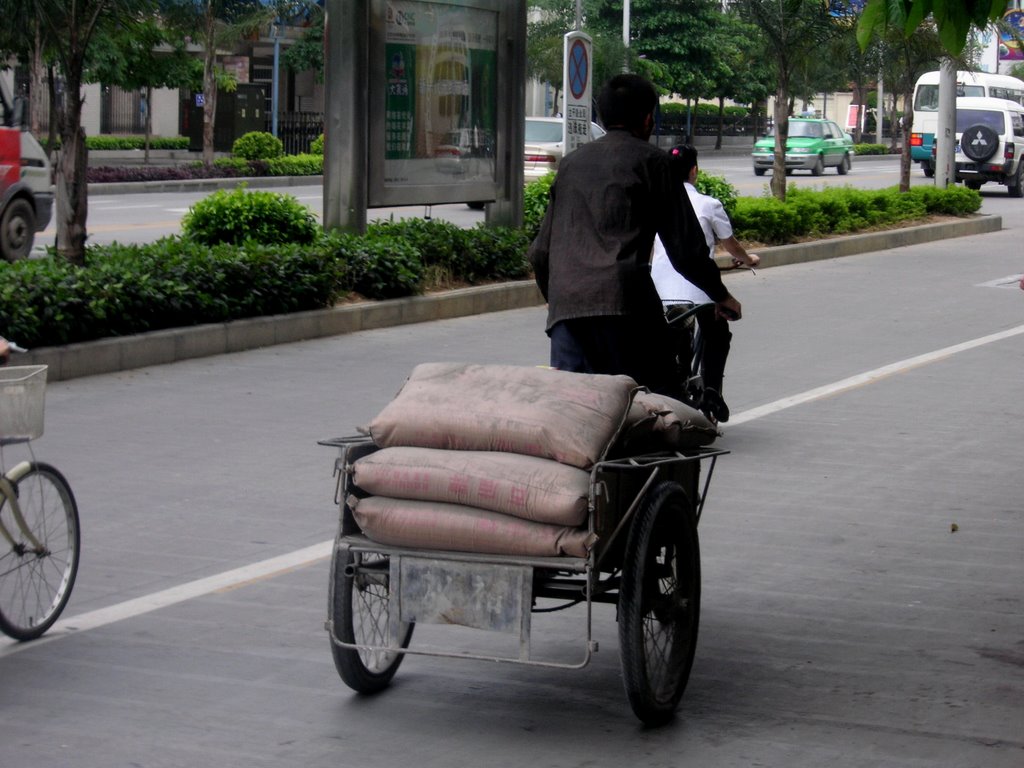
I’m also attaching a picture of a guy I passed on my way in to work, then — the box recycling collector, I suppose he is. Modes of transport are a never-ending source of fascination for me here in Beijing: it truly is every mode invented by humans since the wheel, and just last night I saw (UGH) my first big, bold, brash yellow Hummer. Thanks so much, America, for setting a global standard of wasteful profligate overconsumption to which other nations can aspire. A lot of good it’s doing our planet, huh?
Other aspects of the return I want to note here for the record. I had far more social interactions the first week back than during the entire first six months of my time in Beijing. Connie and Anne are in China on a tour from Pace University; I had them over for dinner Wednesday and took them out to a great dumpling house Friday night; had drinks with Catherine upon my return and again last night, when we also did a bit of Chinese quizzing of each other; I’ve also finally decided I hope not to remain utterly dateless and celibate here in Beijing so I’m taking steps to meet a few like-minded guys, which have already borne fruit in an evening of Risk (yes, Risk!) with two guys I’d met online. Both are fun and interesting, though both will leave by the end of summer.
Then there have been both online and in person conversations about a topic that’s often in my mind here, the fine line between becoming an apologist for the highly objectionable things this government does and has done, and being realistic about the fact that life is far, FAR better for enormous numbers of Chinese people than it has ever been before – and really far more free, not just more comfortable and well-fed. I was honestly both depressed and offended by the simplicity and judgment so many of my interlocutors in the US bring to their view of China.
It’s been so fashionable since 17 years ago today (June 4, 1989 – violent army shutdown of protests in Tiananmen square) for American intellectuals to treat the Chinese government as something of a pariah, and remains so fashionable in some circles to continue acting as though this vast, complex, ever-changing country can be reduced to catch phrases about human rights and territorial expansion. Like the US never went in for territorial expansion? Wonder how descendants of Hawaii’s kinds and queens feel about that, or the Spanish-speaking ancestors of people who lived in New Mexico, Arizona and California before we declared war on Mexico in order to steal all that territory…who are now self-righteously judged for not speaking English, by Johnny-come-lately English-speakers whose ancestors didn’t arrive until a century after these people’s ancestors built their acequias (irrigation systems established in the Rio Grande valley centuries ago that are still used today) and tended their crops in the Rio Grande valley. And we’re not even mentioning the Native American tribes, are we? Would those same people who self-righteously gripe about Tibet and Human Rights accept such a nuance-deprived monochromatic approach the US, a country whose history is a mere blip compared to the history of territorial expansion and retraction and cultural and political growth and shrinkage in China and East Asia?
Ah yes, now I’m working up a head of steam but I should stop before I get boring. My point is: this is a great country to live in now because things are changing so constantly, and beneath the change is this vast, rich, deep reservoir of history and culture and conflict. Denying this, reducing this country to sound bites, says more about the intellect of those doing the reducing that it could ever say about this country. That said: I really don’t want to minimize the bad things this government does, has done and will no doubt continue to do…though as a French guy I was chatting with just yesterday mentioned, Americans are in a weak position to throw stones these days. Guantanamo, anyone? Abu Ghraib, anyone?