Rock Garden, Buildings, Mountains
 Did I mention the weather was completely gorgeous during my time in
Beijing — here in Nanning it hasn’t gotten below 80 even overnight,
and daytime temperatures have always gone over 90 since mid-April;
humidity doesn’t seem to go below 75 or so…and is usually well over
80, I have to think. So we sweat a lot. In Beijing…blue skies, 70s,
low humidity. Lovely.
Temple Gate Detail w/Bamboo
 Though it’s maybe a little hard to see in some of these shots, much of
the temple complex has been very beautifully restored or maintained.
This is a gateway at the bottom of a long series of (sandstone?) steps
that lead to the highest building in the temple complex — you can see
a photo of the skyline shot from there a few photos down — which
houses the clothes Sun Yatsen wore when he was briefly interred here
before being moved to Nanjing for burial. Hmm, I think I have that
right…though come to think of it, it seems rather morbid: taking his
body and leaving the clothes. It raises so many questions that I
choose not to pursue. In any case, part of this complex is referred to
as his “dress tomb” or something of the sort. Sorry I didn’t take
better notes on this!
Still and all: the buildings and many of the details are truly lovely
and interesting, and there really is a sense both of age and of
stillness or serenity in much of this complex.
Mountains and Buildings
 I thought this was a lovely view, and spent some time contemplating
it. There are far more ornate buildings, but none with so lovely a
backdrop.
Temple Building
 I’ve lost track, but I think overall there must be at least 15
buildings, ranging from ornate and elegant buildings like this one, to
small gazebos set beside reflecting pools or walking paths. Inside
some of them are large statues of Buddhas and Boddhisatvas; inside one
of them are literally hundreds of different versions of (I think)
Buddha. For those who don’t know and are interested: there’s only one
Buddha, but he’s portrayed in many ways in the Chinese approach to
Buddhism. I think. There are several Boddhisatvas, people have
attained enlightenment but then, rather than passing into nirvana and
leaving our human plain of existence, choose to remain with us to help
other humans attain enlightenment. Please correct me, via e-mail or
comments posted here or both, if I’m wrong; I’m going from a
(excellent) class on Buddhism at Oberlin 20 years ago, so my details
may be wrong. Part of what interests me about Chinese Buddhism is
that, like some of the approaches you see toward Catholicism in Latin
America, there’s really a great deal of syncretism going on —
elements incorporated into Buddhism here that come from other Chinese
folk, religious, or philosophical traditions and that are not
represented in other strains of Buddhism. Dialogue welcome on this
topic in comments section!
Senior Citizens at the Temple
 As I was heading down and out of the temple complex (and back to the
main park), I saw a rather large tour group of what were clearly
senior citizens from one of China’s minority groups — without any
real basis or knowledge, I’m sort of guessing Tibetan maybe? In the
group were a number of truly interesting women and men, faces
weathered and lined, who really made me wonder what their life stories
would be if I could ask. Given my camera equipment and my reluctance
to intrude on the practice of their religion, I didn’t take any
frontal pictures of them kneeling and bowing as they faced the
statues, but I thought this shot would give you a sense. It’s nice to
know a group like this can freely visit the temple and worship…I
suspect twenty-five years ago, let alone 40 years ago, that would have
been difficult or impossible.
Skyline With Buddhas
 This is the first of two views of the Beijing skyline (assuming these
photos post in the order I hope). Though a small portion of the temple
has been given over to a museum and monument to Sun Yatsen, including
portions of the complex from which this photo was shot, overall much
of the temple is an active temple today — as you saw in the previous
shot of older folks visiting the temple. In light of the many
challenges to the practice of religion that China has seen, especially
during the 60s and 70s (which are referred to, somewhat obliquely, in
the signs at the entrance to the temple complex — they refer to
“destruction” or destructive acts of the temple during something along
the lines of “unrest during the 60s” or some such), I was cheered to
see many people actively worshiping at these buildings, including some
who bowed or saluted these Buddhas and Boddhisatvas.
Beijing from On High
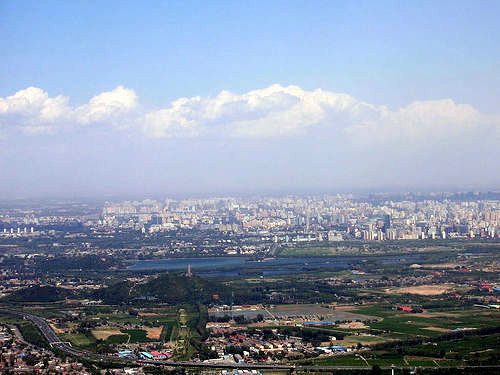
The park also includes the highest mountain close to Beijing —
roughly 500M — which you can either climb on foot via several pretty
steep paths…or take a chair-lift to the top of! I took the chair
lift for the experience, and rather enjoyed thinking about all the
other times I’ve been on chair lifts in interesting and beautiful
places. (Amy, Nancy, and Kip, if you are reading this: yes, I thought
fondly of our time last year in Alta.) From the top, you’ve got a
really nice panoramic view out over all of greater Beijing, as well as
the hills to the north and west – where, another 50K on or so, you’d
get to the most-viewed section of the wall, at Badaling.In this picture, you see a green area with lakes about the center-left
of the photo or so. For those who’ve been, that’s the summer palace —
which gives you a sense of how far out Xiangshan is.
Self-Portrait in Park
 After the long walk around the temple and down the mountain, I found a
lovely grassy area full of flowers (it rather reminded me of Jardins
de Luxembourg, one of my favorite parks in Paris…except there’s more
grass here, and you’re welcome to sit on it!) and settled in to read a
bit and, yes, do some yoga. Just so you’d know it was me taking all
the pictures, I thought I’d document it…not that you can really tell
from this, I guess. 🙂
Oops – Should Be Second Photo
 Oops, I just realized there’s one more photo that I want to put up
here. These are some of the kids that stopped playing ping pong to
pose when they saw me pointing my camera in their direction. This shot
should really be appearing AFTER the next shot, which explains more
about the project and stuff. Sorry.
A Trip to Baoji (and Xian)
 It’s Thursday morning here in Nanning, and I returned yesterday
afternoon from my first trip to our project in Baoji, which was simply
a great trip. To give you some general context, Baoji is in the
southwest of Shaanxi province, more or less in the geographic center
of China. This puts is roughly 1000 km north of Nanning, in an area
where the climate and landscape are much closer to the climate and
landscape of many parts of the US and Europe — lots of farms, grass,
dedicuous trees, rolling hills leading to larger mountins, etc. It was
interesting for me how my heart reacted to seeing green grass and
deciduous tress and “normal” mountains again, after spending a month
here in Nanning where the vegetation is tropical and the mountains are
closer to the unusual (for me) steep mountains of the old Chinese
scrolls.
Baoji is also in a fairly narrow valley between two mountain ranges,
one of which you can see rising in the background in this photo. The
range opposite this one (this shot is looking south, toward Sichuan —
or Szechuan — which begins not too far away to the south of Baoji) is
more of a long high ridge than a mountain range, but together they,
and mountains that continue on both sides of them north and south as I
understand, combine to make Baoji one of the good flat areas from
which to journey westward out of central China, heading most
immediately into the south-eastern reaches of Gansu province, and
ultimately into the Gansu corridor, another much longer defile between
mountains further north and west that, like Baoji, was on the old Silk
Road that we’ve all heard so much about.
Adding to the historical interest that really appeals to me, as a
former student of Chinese history and culture, is the fact that the
nearest airport to Baoji (2-1/2 hours drive away) is the airport for
Xian, which you may have heard of as the city closest to the site of
Chin Shi Huang’s tomb with the terracotta warriors. Though this trip
presented no time either to visit the tomb or to explore the general
area, I am very excited that my job — yes, consider: this is my job
now! — allows me to visit these places and that in the future I’ll be
able to extend a weekend or take a week’s break after a visit to
Baoji, to get into the history of the silk road or visit the tombs.
Then there are the kids, at our project in Baoji — The Children
Center. In the next several shots you’ll see the kids at the center,
and me playing or posing with them. I am not really going to put shots
of our AIDS project in Nanning up here, partly because it’s not really
a photogenic building or area, but mostly because confidentiality and
patient privacy with our patients there is important. In the case of
the children center, as you will see, the kids LOVE (for the most
part) posing for pictures, and the project’s field coordinator tells
me it’s OK to put these on my personal site. This is a project that
provides all round care (housing, meals, school classes as well as
general social and socialization support, and medical care) for street
children. The kids come from literally all over China, because Baoji
is an important railroad crossroads. Some have run away from home;
some have families that left them with relatives or friends when the
parents moved to a big city on the coast to find work, and then when
the parents stopped sending support money the friends or relatives
told the kids they could no longer support them; some simply ran away
from abusive or unhappy homes. The individual stories can be quite
upsetting, but the truly amazing thing about these kids — nearly all
of them — is how well behaved they are, how active they are both in
classes and at playtime, how little they fight or argue with each
other, and so on. Anyway, let’s just say that both these projects here
in China are ones I’m very proud to call my job now.
Badminton Time
 In the mornings and afternoons the kids take formal school classes
(almost all in the center, though a few go to outside public schools)
with teachers employed by MSF. After lunch, and after the afternoon
classes, they get an extended playtime in the courtyard in front of
our building, where there are two ping pong tables (yes, the kids are
amazing and I will never dare to play against them — at a young age
they are already holding the paddle in such a way as to apply very
specific spins to the ball, depending on what they want it to do after
it bounces), a basketball net, and space to play badminton or other
games. Having not picked up a raquet of any sort since leaving LA
(boy, do I ever miss tennis!), I was delighted to see that I have a
workable backhand in badminton and could hold my own quite well with
the kids. The goal, not having a net, is to hit the birdie over the
head of your opponent — or so it seems, at least. I’m really glad I
have some Chinese, because it allowed me to really talk to some of
these kids.
New Friends
 All I’m going to say about this kid is that I had a blast playing
badminton with him, talking with him, and just seeing him interact
with everyone. He is really a great kid, full of energy and with a
real sparkle in his eyes. I’m torn between really hoping he will be
reconnected with his family soon (and that the reconnection will work)
and hoping he’ll be there next month so I can see him again…though
of course if the first happens we’ll all be very happy.
Play Time
 Another shot of one of the kids, with me in the background. Once
Selina, my colleague from Nanning who is medical coordinator for our
two projects here in China, started taking pictures of me playing, and
the kids saw that I was enjoying taking them on in badminton one by
one, many of them started crowding around either for a picture (many
of them are definitely hams when there’s a camera around!) or to play
badminton, or both.
Group Portrait with Paul
 The guy on the right in this photo is one of the older kids in the
center, and he had a lot of fun trying out his English with me and
showing me all the drawings and cartoons in his notebook. It seems he
hasn’t yet quite made his mind if he wants to be Batman or Jackie Chan
when he grows up. Next time I go up, if he’s still there (there was a
rumor he might be able to go home to his family in Shanghai), we’ll
see how his career plans are progressing.
Play Ball!
 What can I say about this one? 🙂


 (so much world, so little time....)