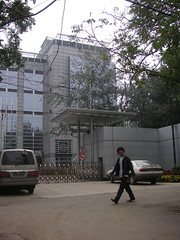
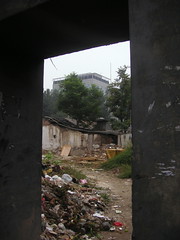
This shot shows a nice new office building that’s been built in the middle of the block (as in, there are four large streets and this is in the middle, away from all of them; it’s a big block) that’s the center of the “destruction zone.” After this you’ll see two shots that show the same building, from different angles and with different foregrounds.
Latest

Beijing: My Road to Work

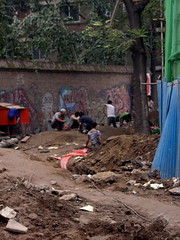
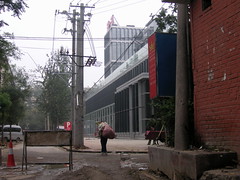
This is literally the road I walk on to get to work, and it’s been changing every day for the past few weeks. Right now the road itself is mostly back — no more big trenches and boards spanning them, but still a few guys soldering and joining the water pipes and so on. But as you see here, it was quite the construction zone for a while, and yet we all still worked our way around the obstacles on our daily errands…as witness this intrepid man with bicycle. The next two shots are the same area, including one from the end with another new building — note the woman walking by with large sacks full of trash (or whatever it is).
Summer Palace – Ceiling Details

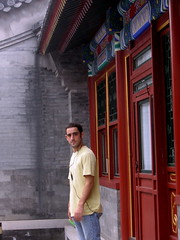
For the first several weeks here in Beijing, I was too busy exploring the city and getting used to my new environs to really take many photos. We also didn’t have a lot of days with very clear skies — pollution and cloud cover (though rarely/never any rain) combined to make the weather not too appealing for photos. But I did go on a couple of hikes in the regions north of Beijing with an expat hiking groups, through whom I’ve met some interesting folks. I also took my colleague Manuel, who’s now back in France, to the Summer Palace. This is one detail shot from the Palace, and after this you’ll see one shot I couldn’t resist: the plastic-potted plant in the window sill of this beautifully-mainained and restored palace complex…and if you look closely, you’ll see it’s a plastic container for San Francisco ice cream. The farther from home I get… 🙂


AIDS Outreach in Nanning
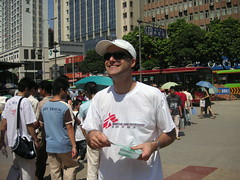
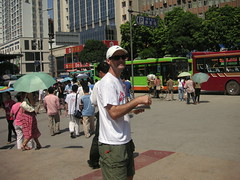
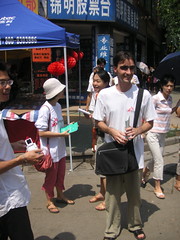
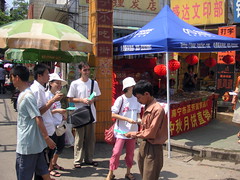
Many of you have noticed that I don’t really comment much on my work with Medecins sans Frontieres. There are several reasons for that: MSF has its own publicity department, of which I’m not a member, so I don’t really feel qualified to speak about it in this open forum; this is my personal blog,and I’m trying to give my friends and family a sense of my life here in general, beyond my day job; but I think, above all, I can’t really capture things like the AIDS project in photos very well: too many issues of privacy and accuracy of information. I’m not a doctor, nor an epidemiologist, nor any sort of expert on AIDS or AIDS in China. But I’ve certainly been learning a lot about health care in China, AIDS in China, and AIDS in general. And I look forward to sharing this with those who are interested,more privately, either when I’m back from this mission or via e-mail. I can certainly say, even in this public forum, that our project is Nanning is one I’m very proud to work with: it’s the only place in Guangxi (so far as I know) where low-income or indigent patients can receive high-standard, complete care, without any cost. The national AIDS policy here in China is currently that any citizen can receive ARV’s — treatment for HIV specifically, but not for any opportunistic infections the patient may have. And since many people aren’t aware of their HIV status, many won’t come in for treatment until they have strong symptoms from one or more OI’s — especially indigent patients who can’t afford basic doctor visits or may live very far away from the nearest reliable center for treatment (think of the kinds of villages I showed you in the essay about our flood relief efforts). Our most common OI is tuberculosis; we also see a number of penciliosis patients: little is known, as I understand it, of the medical aspects of peniciliosis (transmission, etiology if that’s the right word, and so on) — it’s a fungal disease that can penetrate many systems and cause great pain and dysfunction, and if untreated, death. Treatment is quite expensive, so it’s a very good thing for our patients that MSF covers all costs – I suspect that indigent patients in other areas may be unable to find appropriate treatment for peniciliosis. So, with our clinic now nearing its second anniversary and with a stable and growing patient base, we’ve started some outreach efforts. The principal goal of our outreach efforts will be to ensure anyone needing care in the city of Nanning is aware of where we are, and that we offer free, full-spectrum care for HIV positive patients in Nanning. In this shot, and the next several, you’ll see me and some colleagues on our first outreach effort, handing out new fliers that we designed to spread the word. There are some prevention and general HIV education messages in the flier, but again our main goal is to make sure potential patients know where we are and what we offer. We did this on the Saturday of my most recent field visit to Nanning — a few weeks after the coordination team’s move to Beijing. Though we were a bit nervous, it ended up being both enjoyable and reaffirming: lots of good questions from those we spoke with, and seemingly less resistance to the AIDS message than we thought we might find.